Title: A case of rehabilitation after knee surgery
Rehabilitation after knee surgery is a key element in the process of returning to full function and quality of life. Knee surgeries such as arthroscopy, cruciate ligament reconstruction, endoprosthesis or meniscectomy require a carefully planned and individually tailored rehabilitation program. In this article, we will discuss what the rehabilitation process looks like after knee surgery, what techniques and exercises are used, what the goals of rehabilitation are, and what challenges may occur during the process.
1. Types of knee surgery
1.1 Knee arthroscopy
Knee arthroscopy is a minimally invasive surgical procedure that involves inserting a small camera (arthroscope) and surgical instruments into the joint through small incisions. Arthroscopy is used to diagnose and treat various problems of the knee joint, such as damage to cartilage, meniscus, ligaments or foreign bodies.
1.2 Reconstruction of cruciate ligaments
Reconstruction of cruciate ligaments, especially the anterior cruciate ligament (ACL), is a commonly performed operation in athletes and physically active people. The operation involves transplanting a tendon from another part of the body or using an artificial graft to replace the damaged ligament.
1.3 Knee endoprosthesis
Knee endoprosthesis, also known as total knee replacement, involves replacing damaged joint surfaces with artificial implants. This surgery is mainly used for patients with advanced osteoarthritis who experience severe pain and functional limitations.
1.4 Meniscectomy
Meniscectomy is an operation to partially or completely remove the damaged meniscus (articular cartilage) in the knee. The purpose of the operation is to reduce pain, improve joint function and prevent further damage to the joint.
2. Goals of rehabilitation after knee surgery
2.1 Reduction of pain and swelling
One of the main goals of rehabilitation after knee surgery is to reduce pain and swelling. For this purpose, techniques such as cooling, compression and elevation of the limb are used, as well as appropriately selected painkillers and anti-inflammatory drugs.
2.2 Restoring range of motion
Rehabilitation aims to restore full range of motion in the knee joint. Stretching, joint mobilizations and range-of-motion exercises are key components of this process.
2.3 Muscle strengthening
Strengthening leg muscles, especially the quadriceps thigh muscles, gluteal muscles and ischiofemoral muscles, is important for stabilizing the knee joint and improving function. Strengthening and weight-bearing exercises are a key component of a rehabilitation program.
2.4 Improving coordination and balance
Rehabilitation also includes exercises to improve coordination and balance, which is key to preventing falls and injuries in the future.
2.5 Return to daily activities
The ultimate goal of rehabilitation is to enable the patient to return to daily activities, work, sports and recreation. Rehabilitation should be tailored to the patient's individual needs and goals.
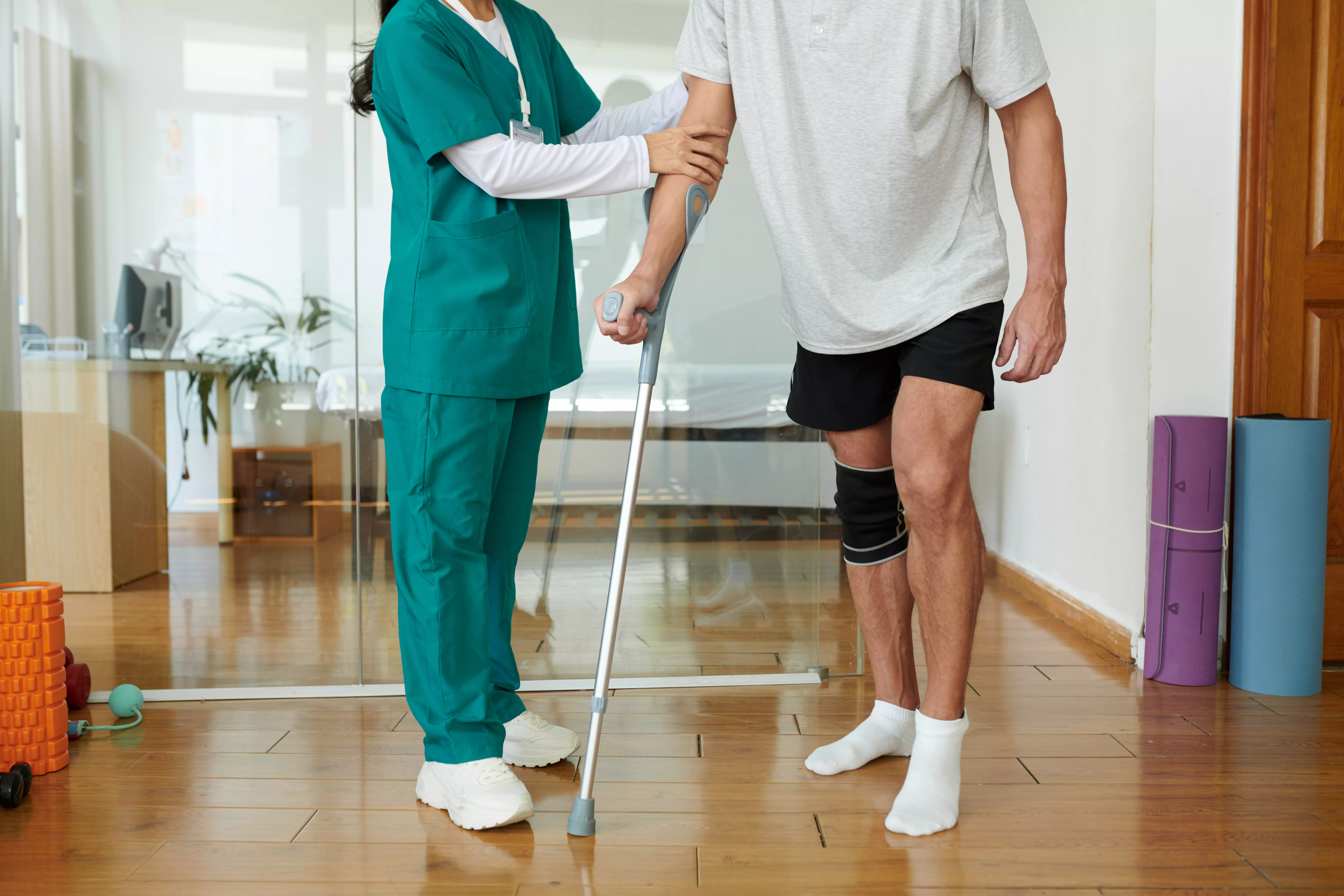
3. Stages of rehabilitation after knee surgery
3.1 Early phase (0-2 weeks after surgery)
3.1.1 Early phase goals
- Reduce pain and swelling
- Protect the operated joint
- Begin to restore range of motion
3.1.2 Techniques and exercises
- Rest and Elevation: Resting the operated limb and elevating it on a cushion help reduce swelling.
- Cooling: Applying ice packs for 15-20 minutes several times a day can reduce pain and swelling.
- Compression: Bandaging the knee with an elastic bandage can help reduce swelling.
- Range of motion exercises: Gentle range-of-motion exercises, such as bending and straightening the knee, can help prevent stiffness.
3.2 Intermediate phase (2-6 weeks after surgery)
3.2.1 Intermediate phase goals
- Continue to reduce pain and swelling
- Increasing range of motion
- Strengthening the muscles of the leg
3.2.2 Techniques and exercises
- Range of Motion Exercises: Continuation of range-of-motion exercises, with more emphasis on achieving full knee flexion and extension.
- Isometric exercises: Isometric exercises, such as stretching the quadriceps muscles of the thigh, can strengthen the muscles without stressing the joint.
- Resistance exercises: Introduce light resistance exercises, such as lifting the leg while lying on the back with elastic band resistance.
- Water exercises: The use of water exercises, such as walking in a pool, can reduce stress on the knee joint and facilitate rehabilitation.
3.3 Late phase (6-12 weeks after surgery)
3.3.1 Goals of the late phase
- Achieving full range of motion
- Strengthening the muscles
- Improving coordination and balance
3.3.2 Techniques and exercises
- Advanced Range of Motion Exercises: Continuation of range-of-motion exercises, with more emphasis on achieving full mobility.
- Strength exercises: Introducing advanced strength exercises, such as squats, leg extensions on a machine and weight lifting.
- Proprioception exercises: Proprioception exercises, such as standing on one leg, walking on unstable surfaces or using a fitness ball, can improve balance and coordination.
- Aerobic exercises: Introducing aerobic exercises, such as stationary cycling or swimming, can improve physical fitness.
3.4 Return to activity phase (12 weeks or more after surgery)
3.4.1 Goals of the return to activity phase
- Continuation of muscle strengthening
- Improve joint function
- Return to full physical and athletic activity
3.4.2 Techniques and exercises
- Specific Sports Exercises: Introducing specific sports exercises to prepare the patient to return to favorite sports activities.
- Plyometric exercises: Plyometric exercises, such as jumps, skips and throws, can improve strength, speed and agility.
- Functional exercises: Functional exercises, such as walking up stairs, lifting objects, or performing daily activities, can help restore full function to the knee joint.
4. Challenges in rehabilitation after knee surgery
4.1 Pain and swelling
Pain and swelling are common challenges in rehabilitation after knee surgery. Effective management of pain and swelling, such as the use of ice packs, compression and elevation of the limb, is key.
4.2 Patient motivation and engagement
Patient motivation and involvement are crucial to the success of rehabilitation. Regular exercise, attendance at physiotherapy sessions and adherence to treatment recommendations can be a challenge, especially in a long-term rehabilitation process.
4.3 Postoperative complications
Postoperative complications, such as infections, adhesions or graft ruptures, can delay the rehabilitation process and require additional medical intervention.
4.4 Individual differences in the healing process
Individual differences in the healing process can affect the speed and results of rehabilitation. Factors such as age, general health, level of physical activity and comorbidities can affect the rehabilitation process.
4.5 Collaboration with the treatment team
Collaboration with the therapeutic team, including the physician, physiotherapist, occupational therapist and nutritionist, is crucial to the success of rehabilitation. Communication, coordination and a collaborative approach to treatment can be challenging, but are essential for optimal outcomes.
5. Sample rehabilitation plan after knee surgery
5.1 Week 1-2 after surgery
- Rest, elevation of the limb, cooling and compression to reduce pain and swelling
- Gentle range-of-motion exercises, such as bending and straightening the knee
- Isometric exercises of the quadriceps muscles of the thigh
5.2 Week 3-6 after surgery
- Continuation of range-of-motion exercises with greater emphasis on achieving full flexion and extension of the knee
- Introducing light resistance exercises, such as leg raises with elastic band resistance
- Beginning water exercises, such as walking in the pool
5.3 Week 7-12 after surgery
- Continuation of advanced range-of-motion and strength exercises, such as squats, leg extensions on a machine
- Proprioception exercises, such as standing on one leg and walking on unstable surfaces
- Introducing aerobic exercises, such as stationary cycling and swimming
5.4 Week 13 and beyond after surgery
- Specific sports exercises to prepare you to return to your favorite sports activities
- Plyometric exercises, such as jumps and skips
- Functional exercises, such as walking up stairs and lifting objects
Summary
Rehabilitation after knee surgery is a key element in the process of returning to full function and quality of life. A carefully planned and individually tailored rehabilitation program can help reduce pain and swelling, restore range of motion, strengthen muscles, improve coordination and balance, and return to daily activities.
Each stage of rehabilitation, from the early post-surgery phase, through the intermediate and late phases, to the return to activity phase, is extremely important and requires patient involvement and cooperation with the treatment team. Challenges such as pain, swelling, patient motivation, post-operative complications and individual differences in the healing process can affect rehabilitation, but with the right techniques, exercises and support, success can be achieved.
Rehabilitation after knee surgery is an investment in health and quality of life, with long-term benefits for both patients and society.
Add comment